
Why this topic, and why now
I run the engineering side of Cixin Solenoid, a Chinese manufacturer that ships custom electromagnets to about 40 countries. Roughly a third of our orders go into self-service equipment: parcel locker banks, vending machines, coffee kiosks, EV charging lockers. The other day a customer in Warsaw emailed me a wiring diagram and asked, plainly, why his solenoid latch was running hot at 24 V. That kind of question is what this article is about.
If you design, source, or maintain automatic parcel lockers (APL) or vending machines, you already know electromagnets live inside almost every one of them. What follows is a practical, slightly opinionated walk-through: which magnet goes where, what specs actually matter on the BOM, and where things tend to fail in the field.
Part 1: The electromagnet in 200 words
An electromagnet is a coil of copper wound around a ferromagnetic core. Send current through the coil and the core magnetizes. Cut the current and the magnetism collapses (assuming a soft-iron core). Three things make that useful in a self-service machine: the field is switchable, the strength follows the current, and a small coil can move a surprisingly heavy armature.
Specs I check before approving any sub-supplier:
| Parameter | Why it matters |
|---|---|
| Holding force (kgf or N) | Drives the safety margin; under-spec it and the door drifts open in summer heat |
| Stroke length (mm) | Distance the armature can move while still pulling enough force |
| Duty cycle (%) | Fraction of time the coil can stay energized without cooking itself |
| Response time (ms) | How fast it latches or releases; affects user-perceived latency |
| Rated voltage (V DC) | Most cabinets run 12 V or 24 V DC; match this exactly |
| Power consumption (W) | Bigger numbers mean a heavier PSU and more heat inside the cabinet |
| Operating temperature | Outdoor APLs need at least −20 °C to +60 °C |
Part 2: Electromagnets inside an automatic parcel locker
2.1 What an APL actually is
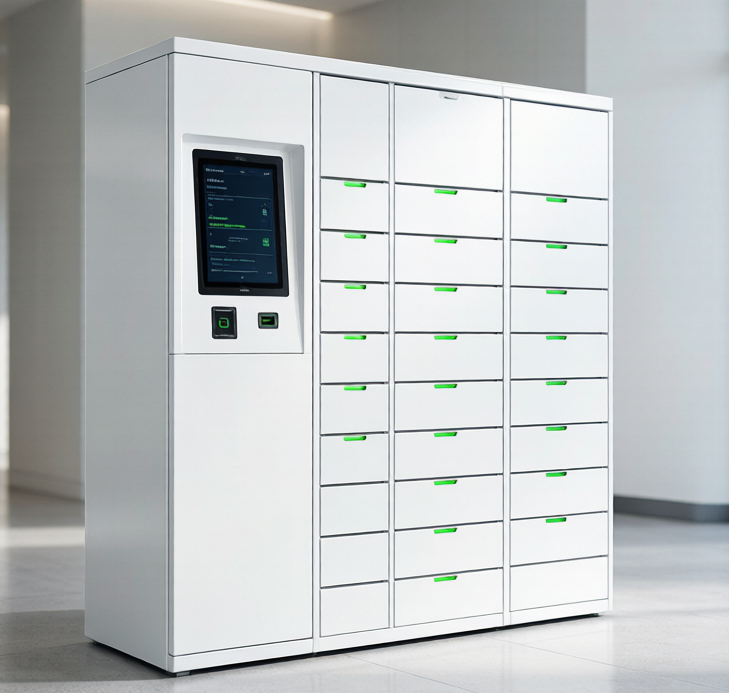
An APL is a steel cabinet with a touchscreen, a payment terminal (sometimes), a 4G modem, and a grid of compartments that open one at a time. InPost in Poland runs more than 20,000 of them; Amazon Lockers, DHL Packstations, Cainiao stations in China, and Korea’s Post24 boxes follow roughly the same architecture. Each compartment door needs a lock that releases in under 200 ms when the controller says so, and stays locked for the other 99.99% of the day.
2.2 The locking mechanism: where the electromagnet earns its keep
Two designs dominate.
A. Electromagnetic lock (maglock). A coil pulls an armature plate against the lock body. Force stays at 280–600 kgf as long as current flows. Pros: dead simple, no moving parts to wear. Cons: it eats power continuously, runs hot, and the moment your UPS dies the door swings open. We only sell maglocks for the main service door of a locker bank, never for individual compartments.
B. Solenoid-actuated latch. A solenoid drives a pawl that engages a striker on the door. Power is only needed at the moment of unlock. This is the workhorse for individual compartments. A typical 24 V unit pulls 8 W for 80 ms, then sits idle at zero current for the next 10 minutes.
2.3 Door-actuation motors
On smaller compartments a spring plus the solenoid is enough. On the bigger doors (think laptop or stroller size) you usually see a DC gear motor or a stepper driving a cam that pushes the door open. That motor is itself an electromagnetic device. Current sensors on the motor line tell the controller if the door jammed (current spikes) or if the door is already gone (current drops to zero).
2.4 Environmental stress
Outdoor APLs take everything: rain, dust, −25 °C winters in Sweden, +55 °C summers in Riyadh. Coil insulation has to be Class F or H (155°C / 180°C rated). Connectors should be IP67. We’ve seen more warranty claims from corroded pins than from failed coils.
2.5 Specs we ask clients to confirm for a compartment latch
| Specification | Typical value |
|---|---|
| Voltage | 12 V DC or 24 V DC |
| Stroke | 3 to 8 mm |
| Holding force | 0.5 to 5 kgf depending on door size |
| Response time | under 100 ms |
| Operating temperature | −20 °C to +60 °C |
Part 3: Electromagnets inside a vending machine
3.1 A vending machine is more than a locker with snacks
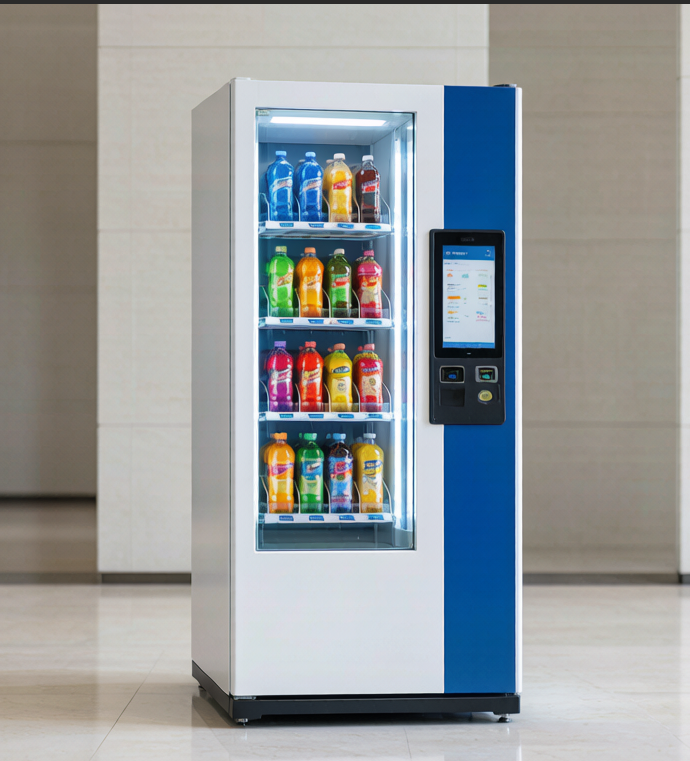
A locker does one thing: lock and unlock. A vending machine does five: hold inventory, take payment, dispense the right product, give change, and (often) keep things cold. Electromagnetic components show up in all five subsystems.
3.2 The spiral dispenser
The classic snack machine has a DC motor per spiral shelf. The motor turns the spiral exactly one revolution. The product, sitting on the spiral, gets pushed forward and falls off the end into the pickup bin. A small solenoid then opens a flap at the bottom of the chute so the product doesn’t bounce back. These motors are cheap (a couple of dollars each in volume) and they’re the most-replaced part in any vending fleet.
3.3 The payment stack
Three subsystems, three electromagnetic tricks.
Coin acceptor. Inside the validator are a few inductive coils. Each inserted coin disturbs the field in a specific way, and the controller compares that signature against a library of known coins. Fakes get rejected. Foreign coins get rejected. This is induction in its purest form, not a solenoid but the same physics.
Bill reader. Paper validators still rely on magnetic ink sensors. The ferromagnetic particles in the ink perturb a small electromagnet’s field as the bill slides past, and the pattern has to match. UV and optical checks are layered on top, but the magnetic check is still the gatekeeper.
Card reader. The magstripe head is a tiny inductive pickup. The stripe’s stored magnetic flux induces a voltage as it moves past the gap. Chip and contactless work on different principles, but legacy readers still use the inductive head.
3.4 The reach-in door
Glass-front beverage machines let the customer open the door themselves after payment. A solenoid lock holds the latch. On payment confirmation the controller drops the solenoid for about 200 ms, the spring pops the door open an inch, and a linear solenoid or a small motor drives the door seal back so the gasket releases. On refrigerated units the seal solenoid matters: a half-engaged gasket leaks cold air and the compressor never cycles off.
3.5 Refrigeration and thermal control
The compressor is the biggest electromagnetic load on a refrigerated vending machine, often 200 to 400 W. Door heaters and anti-sweat strips on the glass are resistive (I²R) loads driven by simple thermostats. Both are technically electromagnetic but not what buyers mean when they ask about “the magnet”.
3.6 Premium machines with conveyors and elevators
Higher-end vending (think cosmetic dispensers, electronics vending, Japan’s book-vending machines) use stepper motors for the conveyor and linear actuators for the elevator. Stepper motors give you precise positioning without closed-loop feedback, which is why you see them everywhere in vending. Some Japanese machines also use voice-coil actuators for delicate items — the same tech that drives a hard-disk head.
Part 4: APL vs vending machine, side by side
| Aspect | Automatic Parcel Locker | Vending Machine |
|---|---|---|
| Primary electromagnetic job | Locking and unlocking compartments | Product dispensing and payment sensing |
| Dominant actuator type | Solenoid latch or maglock | DC motor for spiral, solenoid for flap and door |
| Security priority | High — every dollar of unattended goods is at risk | Low to medium |
| Usage pattern | Idle 99% of the time, short bursts | Frequent, often sustained operation during business hours |
| Operating environment | Often outdoor or semi-sheltered | Indoor, climate-controlled |
| Power profile | Standby is tiny, but UPS must keep locks engaged | Refrigeration dominates the energy bill |
| Fail-safe requirement | High — doors must remain locked during power loss | Medium — most systems fail open |
| Wear profile | Low electrical wear, high mechanical latch wear | Moderate motor wear, spiral degradation |
Part 5: What I look at when a customer asks for a quote
This is the section where most spec sheets go wrong, in my experience. People fixate on holding force and forget the duty cycle. Or they pick a maglock for a battery-powered cabinet and then wonder why the battery dies overnight.
5.1 Force versus stroke
Holding force falls off fast as the air gap grows. Rule of thumb from our lab data: every extra 0.1 mm of gap costs you roughly 10–15% of force on a typical solenoid. So if your latch design has any tolerance stack-up (and it does — every door fits slightly differently), spec the magnet with at least 30% force margin above the worst case.
5.2 Heat dissipation
A 30-compartment bank with continuous-duty latches would cook itself. We default to intermittent-duty solenoids (rated for 25% or 10% duty) and we use PWM to drop the holding current to about 30% of the pull-in current after the latch engages. Cuts heat by a factor of three with no change in holding force.
5.3 Fail-safe versus fail-secure
This is the conversation I have most often with integrators.
Fail-safe means power off unlocks the door. Good for the customer-facing compartment because the user needs to get their parcel during a blackout. Needs a UPS sized for the lock current for the outage window (typically 4 to 24 hours).
Fail-secure means power off keeps the door locked. Good for the master service door and for high-value compartments. Needs a physical key override because the technician still has to get in when the battery dies.
Most banks we ship use a hybrid: fail-secure solenoid latches per compartment, fail-safe maglock on the service door, both backed by a single LiFePO4 battery pack.
5.4 Noise
Solenoids click. In a luxury apartment lobby the click annoys residents more than you’d think. Three fixes we’ve shipped: soft-start driver circuits that ramp the current over 50 ms, hydraulic dampers on the armature, and brushless motors on conveyor-driven doors. None of them are free; the soft-start circuit is the cheapest and most underrated.
5.5 Standards you cannot skip
UL 60335 / IEC 60335 for general electrical safety, IP65 or better for outdoor APLs, IEC 61000 for EMC (otherwise your maglock kills the 4G modem’s reception), and PCI-DSS for any payment-handling component in a vending machine. We get questions about CE and UKCA every week. Yes, we have both.
Part 6: Where the technology is heading
6.1 Smart monitoring
Current sensing on every coil and motor is becoming standard. If the latch draws 30% more current than last week, the controller flags it before it fails. If a vending motor stalls, the system pings the operator with the exact slot number. We’re now shipping solenoids with a built-in hall-effect sensor that reports the armature position to the controller board via a single extra wire. Five cents of BOM, hours of saved truck rolls.
6.2 Bi-stable latching solenoids
Bi-stable latches hold position with a permanent magnet and only need a brief pulse to flip. Zero standby current. This is the single biggest efficiency gain available to a battery-powered APL. We’ve run a 12-compartment solar-powered cabinet in the Gobi desert on a 20 Ah battery for 14 months with bi-stable latches; the previous design with conventional solenoids lasted 6 weeks. Numbers from a real deployment, not a brochure.
6.3 Energy harvesting and solar
Outdoor APLs are moving to solar. The constraints this puts on the magnet designer are real: variable input voltage means the driver circuit has to compensate, and standby current must be near zero. Bi-stable latches, again, are the answer.
Part 7: Field troubleshooting cheat sheet
These are the seven problems I get asked about most often. Symptom, what we’ve actually found in the field, what fixed it.
| Symptom | Likely cause | Solution |
|---|---|---|
| Solenoid will not release | Coil open circuit or wiring disconnected | Check the harness with a multimeter; replace the solenoid |
| Door pops open on its own | Insufficient holding force; air gap too large | Re-align the door; check latch striker position; verify coil voltage under load |
| Intermittent latch operation | Partial short in the coil or corroded connector | Clean and reseat connectors; measure coil resistance against spec |
| Vending motor stalls mid-rotation | Motor shaft sheared or gear stripped | Replace the motor/gearbox assembly; check for foreign objects in the spiral |
| Latch sticks in the engaged position | Mechanical obstruction or worn return spring | Clean the latch path; lubricate lightly with silicone grease; replace the spring |
| Solenoid coil runs hot to the touch | Continuous-duty solenoid in an application that needs intermittent duty | Upgrade to an intermittent-duty unit; add PWM hold current; improve cabinet ventilation |
| Coin acceptor rejects valid coins | Inductive sensor out of calibration or covered with debris | Run the validator’s calibration routine; clean the coin path with the manufacturer’s cleaning card; replace the sensor module if it persists |
Closing thoughts
Electromagnets are not a footnote in self-service equipment. They are the parts that fail when no one is watching, and the parts that determine whether a user comes back. Pick the right one, drive it with the right circuit, and give it a margin for the worst-case temperature on a Tuesday in August. Most field failures we see come from a spec that was technically correct on paper but ignored the duty cycle, the ambient temperature, or the tolerance stack-up on the door.
If you’re designing an APL or a vending machine and want a sanity check on the solenoid choice, you can send us your drawing. We’ll tell you in plain English whether the spec works, and what we’d change.
Written by the engineering team at Cixin Solenoid. Manufacturers of custom electromagnets, solenoid valves, and latching magnets for self-service, medical, and industrial equipment.